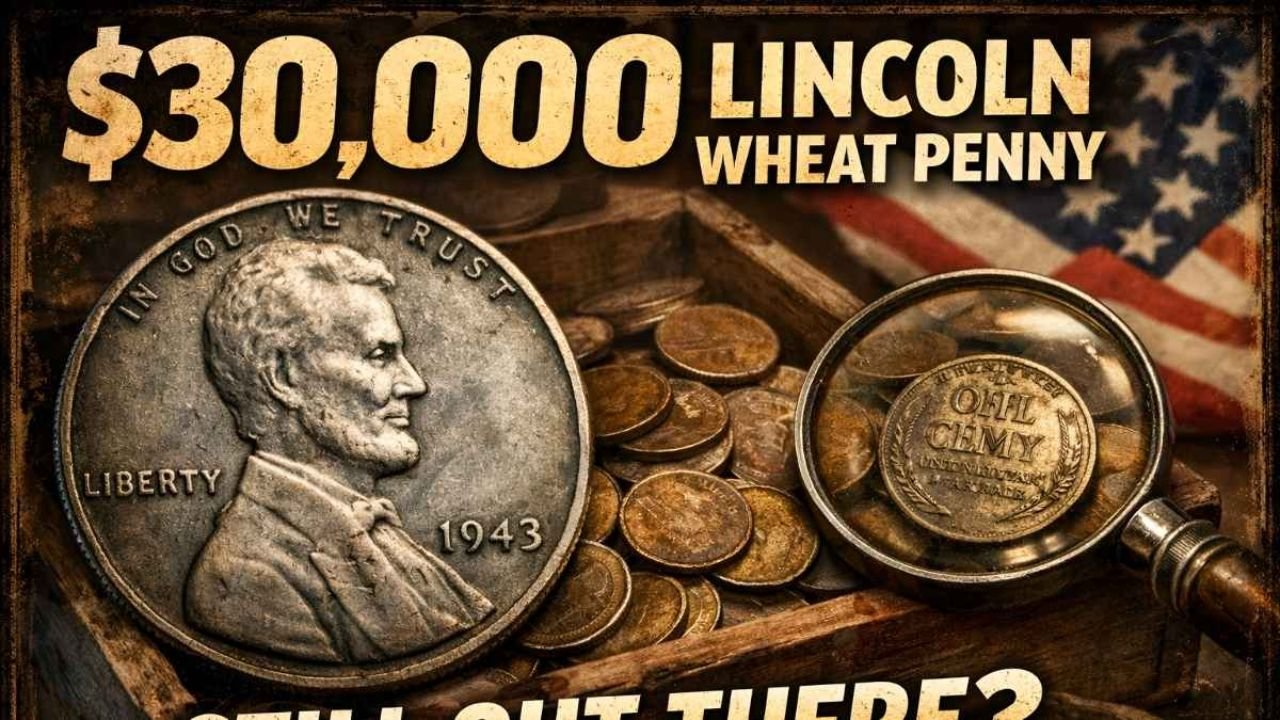
The idea that a single penny could be worth $30,000 sounds almost unbelievable. Yet in the world of rare coins, extraordinary valuations are not only possible—they are documented realities. The Lincoln Wheat Penny, minted from 1909 to 1958, remains one of the most collected and studied coins in American history. And while most examples are worth only a few cents, certain rare varieties have reached five-figure price levels at auctions.
The real question is not whether a $30,000 Wheat Penny exists. It does. The more intriguing question is whether one could still be hiding in everyday circulation.
The Legacy of the Lincoln Wheat Penny
Introduced in 1909 to commemorate the 100th anniversary of Abraham Lincoln’s birth, the Lincoln Wheat Penny marked a historic shift in U.S. coin design. It was the first American coin to feature an actual person rather than a symbolic figure.
Designed by Victor David Brenner, the obverse displays Lincoln’s portrait, while the reverse features two wheat stalks framing the denomination. The design remained in production until 1958, when it was replaced by the Lincoln Memorial reverse.
With nearly five decades of mintage, billions of Wheat Pennies entered circulation. This large production explains why many still appear in old collections, coin jars, and inherited boxes of change.
Why Some Wheat Pennies Are Worth $30,000 or More
Most Wheat Pennies carry minimal value. However, specific factors can transform an ordinary coin into a high-value collectible.
1. Rare Dates and Low Mintages
Certain years had significantly lower production numbers. Coins such as the 1909-S VDB or 1914-D are particularly scarce. Limited supply combined with strong collector demand drives prices upward.
2. Minting Errors
Error coins often command premium prices. Off-metal strikes, double dies, and transitional errors—such as bronze pennies struck during years when steel was standard—can reach extraordinary values.
3. Exceptional Condition
Condition is critical in coin valuation. A common-date Wheat Penny in heavily circulated condition may be worth only a few cents. The same coin in pristine, uncirculated condition with sharp detail and original luster can sell for thousands.
High-grade certified coins graded by professional services often achieve record-breaking prices at auction.
The Famous High-Value Examples
While not every valuable Wheat Penny is worth exactly $30,000, several documented sales fall into that range or higher.
One notable example is a 1943 bronze cent. During World War II, pennies were struck in steel to conserve copper. A small number were mistakenly struck in bronze, making them among the rarest U.S. coins ever produced. Depending on condition, these coins have sold for tens of thousands—and in some cases, far more.
Similarly, rare high-grade versions of key-date coins have crossed the $30,000 threshold when certified in top condition.
These valuations are driven by rarity, authentication, and market demand—not speculation.
Could One Still Be in Circulation?
In theory, yes.
Although the odds are slim, rare coins occasionally resurface in circulation. Many people are unaware of what to look for. Over the decades, inherited collections have been unknowingly spent, and valuable coins have been deposited back into banks.
Because Wheat Pennies were minted in such high volumes, they often blend seamlessly with ordinary coins. A rare variety does not look dramatically different at first glance. Without careful inspection, it can easily go unnoticed.
Stories of valuable coins discovered in pocket change continue to emerge, reinforcing the idea that hidden treasures can still exist.
How to Identify a Potentially Valuable Wheat Penny
If you are curious about searching your own coins, start with a systematic approach.
Check the Date and Mint Mark
Look beneath the date for a small letter indicating the mint:
- No letter: Philadelphia
- D: Denver
- S: San Francisco
Certain combinations of year and mint mark are far scarcer than others.
Examine the Material
For 1943 pennies, use a simple magnet test. Steel cents are magnetic; bronze cents are not. If a 1943 penny does not stick to a magnet, it may require professional evaluation.
Assess Condition
Coins with sharp details, minimal wear, and original shine are significantly more valuable than worn examples. Avoid cleaning coins, as this can drastically reduce their value.
Seek Professional Authentication
If you suspect you have a rare coin, consult a reputable coin dealer or submit it to a professional grading service. Authentication is essential for confirming rarity and maximizing value.
The Role of Auctions and Market Demand
Coin values are ultimately determined by market demand. Auctions provide transparent pricing data and often set record valuations for rare coins.
High-net-worth collectors, investment-focused buyers, and institutions actively compete for exceptional examples. When rarity meets condition, bidding can escalate quickly.
However, it is important to understand that auction-level prices apply only to authenticated, rare specimens—not to average circulated coins.
Separating Fact from Hype
Online headlines frequently exaggerate coin values, leading to unrealistic expectations. While a $30,000 Wheat Penny is absolutely possible, it represents a tiny fraction of total coins produced.
The majority of Wheat Pennies are worth between a few cents and a few dollars, depending on condition.
Education is the most valuable tool for collectors. Understanding grading standards, mintages, and market trends prevents disappointment and helps identify genuine opportunities.
Why the Fascination Endures
Beyond financial value, the Lincoln Wheat Penny represents a tangible connection to American history. These coins circulated during two world wars, the Great Depression, and decades of economic transformation.
Holding one is like holding a small artifact from another era.
For many collectors, the appeal is not solely about profit. It is about preservation, history, and the thrill of discovery.
Final Verdict: Is It Still Out There?
Yes, a $30,000 Lincoln Wheat Penny exists—and while rare, it is not impossible that one remains undiscovered.
The probability is low, but not zero. Coins continue to move through estates, forgotten jars, and inherited collections. Every so often, a remarkable find reminds collectors that extraordinary value can hide in plain sight.
If you choose to search your change, approach it with curiosity rather than expectation. Most pennies will be ordinary. But in the world of numismatics, even the smallest coin can carry remarkable significance.
And occasionally, it can carry a five-figure price tag.